Exhibition Printing in London: How to Stand Out and Generate Real Leads
Exhibitions in London can be one of the fastest ways to generate high-value conversations, but only if you treat your stand like a lead system, not a display.
Most exhibitors focus on the wrong thing. They obsess over how the stand looks, then wonder why they leave with a pile of business cards and no measurable return.
In 2026, standing out and generating real leads comes down to three things:
- Booth psychology that stops the right people
- Print assets that communicate value instantly
- Lead capture and follow-up systems that turn footfall into revenue
This article breaks down what actually works, and how to use banners, flags and gazebos strategically, without wasting budget on generic printing.
Why exhibition printing still works in London
London is packed with industry events, trade shows and conferences. Decision-makers attend because they want to discover suppliers, compare options and solve problems quickly. The opportunity is real, but the competition is intense. If your stand is visually quiet, unclear, or poorly positioned, you become part of the background.
The goal is not to be the loudest stand. The goal is to be the clearest stand for the right audience.
Start with ROI, not print
Before choosing a pull-up banner or fabric wall, define what success means.
A simple ROI model for exhibitors
- Footfall to stand: how many relevant people stop
- Qualified leads captured: how many match your ideal client
- Booked next steps: how many meetings, demos or calls get scheduled
- Revenue outcomes: how many turn into clients
If you cannot measure at least leads and booked next steps, the event becomes expensive brand awareness with no commercial proof.
Booth psychology that makes people stop
Your printing is not just decoration. It is a behaviour trigger.
The 3-second clarity rule
Most attendees are scanning while walking. You have a very short window to answer:
- Who is this for?
- What do they do?
- Why should I care?
If your banner headline is vague, you lose them.
Weak headline examples:
- Innovative solutions for your business
- Quality you can trust
Stronger headline examples:
- Dental implant leads for London clinics
- Commercial HVAC contracts, not small jobs
- Retail fit-outs delivered on time and on budget
Clarity attracts the right people and repels the wrong people. That saves your team time.
Visual hierarchy matters
High-performing stands follow a simple hierarchy:
- One primary message at distance
- One supporting proof point (numbers, outcome, niche)
- One clear call to action (scan, book, talk)
This is where print choices support conversion, not aesthetics.
What to print for real lead generation
There is no universal best set of materials. The right mix depends on your environment, your space, and how people move through the venue.
However, these are the assets that tend to create the biggest impact in London expo environments.
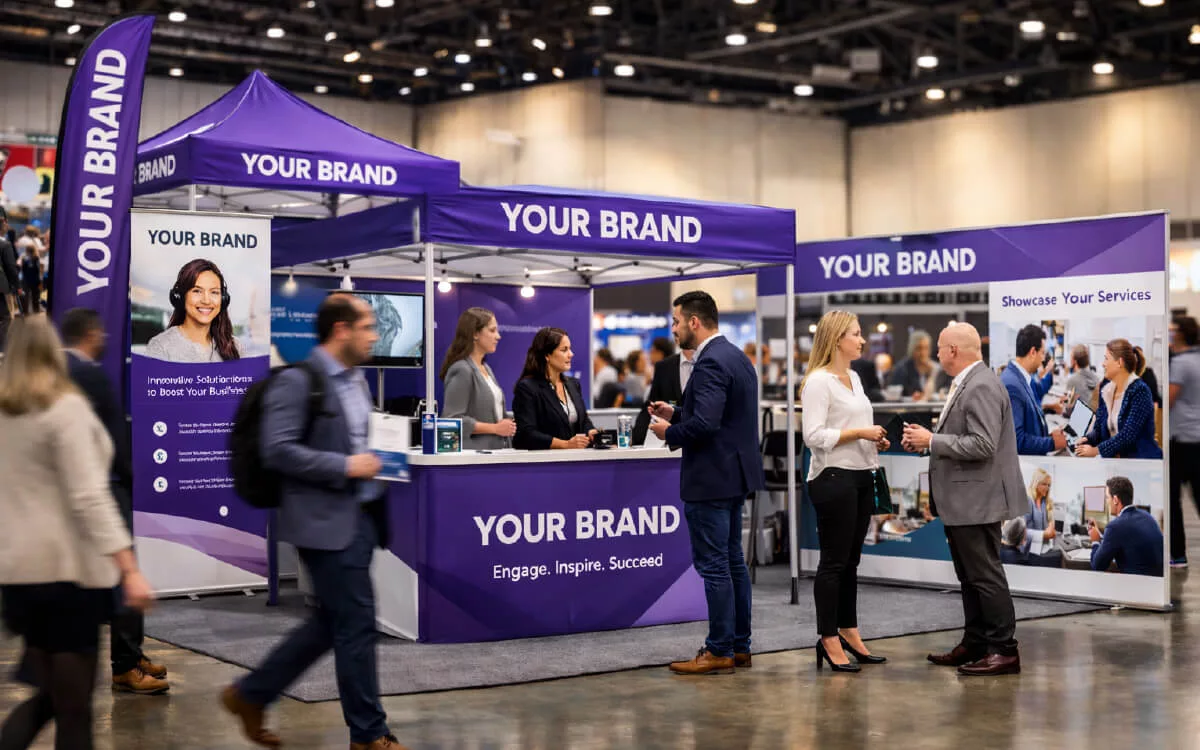
Pull-up banners: best for fast clarity and modular stands
Pull-up banners work when you treat them like sales tools, not brochures.
Use them for:
- One service per banner
- One niche per banner
- One offer per banner
If you have three core services, you often want three banners, not one banner trying to do everything.
Pro tip: Place banners where people enter the stand, not behind your team. They should stop people before they walk past you.
Flags: best for visibility in crowded halls
Flags are a visibility asset, especially in busy spaces where sight lines are blocked by other stands.
They work well when:
- Your brand name is short and readable
- Your colour contrast is strong
- Your message is not overloaded
Flags are not ideal for detailed messaging. They are ideal for being seen early.
Gazebos: best for outdoor events, trade days and local activations
Gazebos are highly effective for:
- Outdoor markets
- Construction and trade supplier events
- Local authority or community events
- Car parks and forecourts
- Sports sponsorship activations
They create an instant branded space, which increases trust and professionalism. If you are a trades business or service provider, a branded gazebo and uniform setup can significantly lift perceived credibility before you say a word.
Display walls and backdrops: best for authority and photos
Fabric walls and backdrops are powerful in London because they look premium, create a strong branded frame, and improve event photos and social content.
If you plan to run post-event ads, social recaps, or PR, a good backdrop becomes a marketing asset beyond the show floor.
The lead capture system that makes print pay for itself
Print gets attention. Systems convert attention into revenue.
Use QR codes properly
QR codes work well when they lead to something valuable and fast.
Instead of a QR code that points to your homepage, use:
- An event-only landing page
- A calendar booking link
- A downloadable offer (guide, checklist, price range)
- A show offer that expires after the event
If you want ROI, your QR destination must have one job: capture the next step.
You can also track scans, completions and conversion rates if you route QR codes to dedicated URLs and track events in analytics. This is one of the simplest ways to connect offline activity to measurable performance.
Make it easy for the visitor
Your QR landing page should include:
- A short headline that matches the stand message
- A one-field or two-field form (name and email, or name and phone)
- A clear next step (book, request, download)
- Trust signals (reviews, logos, proof)
If the form is long, your conversion rate drops.
GDPR and consent: do it properly
If you are collecting personal data at an event, you need to handle it responsibly. Practical approaches that help keep you compliant include:
- Use clear opt-in language on forms
- Avoid pre-ticked boxes
- Store lead data securely
- Tell people what follow-up they will receive
- Only share data with partners if you have a clear lawful basis and have informed people
For many exhibitors, the cleanest approach is to treat QR scans and form fills as explicit opt-ins, with clear wording and a link to your privacy policy.
The mistake most exhibitors make: no follow-up plan
Exhibitions do not fail because the print was bad. They fail because follow-up is slow, inconsistent, or non-existent.
The highest-performing exhibitors treat follow-up like a campaign.
A simple post-event follow-up structure
Day 0 to 2:
Great meeting you email with the promised asset, plus a booking link for the next step.
Day 3 to 7:
Case study or proof email relevant to their sector, plus an invite to a call or quote.
Day 7 to 21:
Light retargeting ads to event visitors, plus a final follow-up that offers a clear next action.
This is where event marketing becomes a predictable system.
How Promoworx approaches exhibition printing differently
We treat print as part of a wider growth system.
That means we look at:
- Your offer positioning
- Your stand messaging hierarchy
- Your lead capture method and tracking
- Your landing page structure
- Your follow-up plan (email, ads, automation)
Then we design and print the assets that support that strategy, not just the assets that look nice.
The result is a stand that communicates value quickly, attracts the right visitors, captures leads consistently, and produces measurable outcomes.
Checklist: what serious exhibitors should do before printing anything
- Define your ideal client and your primary offer
- Choose one headline that is instantly clear
- Build an event landing page and tracking
- Decide how you will capture leads (QR, form, booking)
- Plan follow-up before the event starts
- Choose print assets based on space, flow, and visibility
- Keep design clean, readable and proof-led